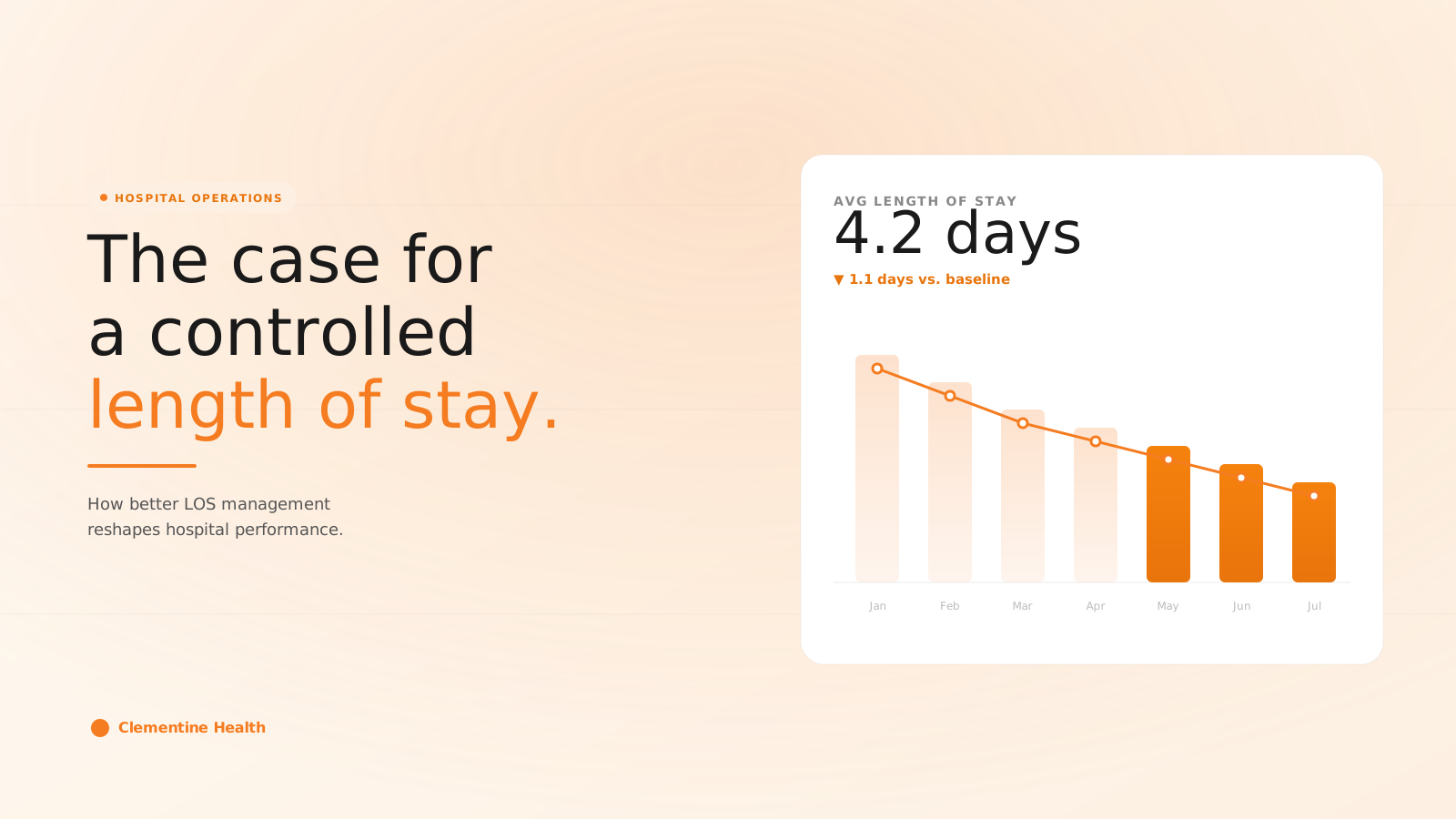
In every hospital, there is a quiet tension between two clocks. The first is clinical — the time a patient actually needs to be in an acute-care bed. The second is operational — the time it takes for prior authorizations, post-acute placement, referrals, transportation, and internal handoffs to catch up. When those two clocks drift apart, the gap has a name: avoidable length of stay.
The industry knows this gap is expensive. What's less appreciated is how much is actually hiding inside it — financially, clinically, and culturally. A controlled, consistently shorter length of stay (LOS) isn't just a cost-reduction story. It's a compounding advantage that reshapes how a hospital performs on every other metric that matters.
What a single avoidable day actually costs
Depending on the facility and case mix, the marginal cost of an inpatient day in the United States typically lands somewhere between $2,000 and $3,000. For most hospitals, a single avoidable day per discharge — across a census of several hundred patients — translates into seven- or eight-figure annual drag on operating margin.
But the direct cost is often the smallest part of the picture. The real damage lives in four places:
- Lost throughput. Every extra day an admitted patient occupies a bed is a day a new admission can't start. In capacity-constrained hospitals, that shows up as ED boarding, canceled electives, and diverted transfers — the highest-margin volume a hospital has.
- Payer pressure. DRG-based reimbursement is largely fixed per case. Every day past the geometric mean LOS on a CMS MS-DRG is a day the hospital is paying for out of margin, not collecting for.
- Clinical risk. The longer a patient stays, the higher the probability of a hospital-acquired condition, a fall, a medication error, deconditioning, or a delirium episode that resets their discharge plan entirely.
- Staff burn. Case managers, social workers, and floor nurses absorb the coordination work for every stuck patient. Stuck patients are the loudest, hardest, most emotionally draining cases on the board.
Why LOS is a leading indicator, not a lagging one
Most hospital scorecards treat LOS as an outcome — something to measure after the quarter closes. That framing is backwards. LOS is a real-time read on how well upstream processes are functioning: admission risk stratification, documentation, prior auth turnaround, SNF and home-health referral cycles, transportation, pharmacy reconciliation, and communication between attendings and case managers.
When LOS creeps up, it is almost never because clinical acuity changed overnight. It's because one or more of those upstream processes started dropping work on the floor. A controlled LOS is what it looks like when none of them are.
"Discharge should happen when patients are ready — not when the paperwork catches up."
The compounding effects of a shorter LOS
1. Bed capacity expands without building anything
A half-day reduction in average LOS across a 300-bed hospital effectively creates dozens of additional discharges per month — functionally equivalent to new bed capacity, at a fraction of the cost of construction or staffing. That capacity usually gets absorbed by higher-margin surgical and transfer volume, which is the fastest way to improve contribution margin without changing payer mix.
2. Readmissions often drop, not rise
There's an old concern that discharging sooner means bouncing back sooner. The data consistently shows the opposite when LOS is shortened through better coordination rather than shortcuts. Patients discharged on a clean, pre-planned trajectory — with the right post-acute setting, medications reconciled, durable medical equipment ordered, and a real follow-up appointment on the calendar — readmit less than patients who stayed an extra two days because a packet was sitting in a queue.
3. Clinical quality improves on its own
Shorter stays mean fewer lines, fewer catheter-days, less immobility, less delirium, less exposure to the hospital environment itself. CAUTI, CLABSI, C. diff, and falls are all partially dose-dependent on time in the bed. Hospitals that bring LOS under control often see hospital-acquired condition rates fall without running a separate quality improvement project against any of them.
4. Staff reclaim their day
Case management productivity is the single most under-measured lever in the discharge process. A case manager spending three hours on a phone tree for a single prior authorization is not available for the other fifteen patients on their list. When the coordination work is either automated or front-loaded to Day 1, the same team quietly handles more volume — and stops leaving at 7 p.m. to finish notes.
Where avoidable days actually come from
When we audit discharge data across hospital partners, the avoidable days almost always cluster in a small number of categories:
- Prior authorization delays. Post-acute placements (SNF, IRF, LTACH), home health starts, and DME orders routinely wait 24–72 hours for a payer decision that could have been initiated on Day 1.
- Late-breaking placement. A patient is discharge-ready on Wednesday morning; the SNF referral goes out Wednesday afternoon; the accepting facility doesn't have a bed until Friday.
- Documentation mismatches. Referral packets missing the specific clinical documentation a payer or receiving facility needs, triggering a return-to-sender cycle.
- Weekend and holiday decay. Processes that depend on business-hours staffing at payers, SNFs, or agencies simply stall from Friday afternoon to Monday morning.
- Internal handoffs. Case managers not knowing a patient is discharge-eligible until rounds, then starting the coordination work from scratch.
None of these are clinical problems. All of them are coordination problems. Which is why LOS responds so well to better coordination — and why the hospitals that have figured this out are pulling away from the rest of the field.
What "controlled" actually looks like
A hospital with a controlled LOS tends to share a handful of characteristics:
- Every admission gets a Day 1 discharge barrier prediction — insurance, placement, equipment, social — before the patient is even on the unit.
- Prior authorizations are initiated the day a post-acute need is identified, not the day the patient is cleared for discharge.
- Post-acute referrals go out to multiple facilities in parallel, with acceptance status tracked in one place.
- Case management has a single dashboard for every patient on the board, ranked by discharge risk — not a chart-by-chart scavenger hunt.
- Avoidable days are tracked with a cause code, not just a count, so the root cause gets fixed the next week instead of reported the next quarter.
None of this requires new beds, new staff, or a rip-and-replace of the EHR. It requires treating discharge coordination as the high-leverage workflow it actually is — and giving the people running it tools that match the complexity of the work.
The bottom line
Length of stay is the metric that sits on top of every other hospital operating problem. Pull it down in a controlled, sustainable way, and the finances, the quality scores, the capacity, and the staff experience all move with it. Let it drift, and every other initiative in the organization has to swim against the current it creates.
The hospitals that will win the next decade aren't the ones spending the most on throughput dashboards. They're the ones that figured out — sometimes the hard way — that a controlled LOS is the output of a system that actually knows what's about to go wrong on every patient, and starts resolving it on Day 1.